


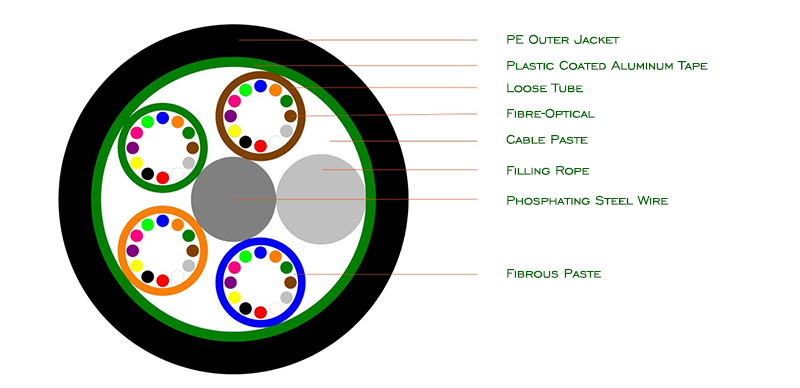
Fiber core number | 4 | 6 | 12 | 24 | 48 | ||
Typeof optical fiber | G.652D | ||||||
Design (reinforcement+loose sleeve and filling) | 1+5 | ||||||
Center reinforcement | material | Phosphating steel wire | |||||
diameter(±0.05)mm | 1.4 | ||||||
Loose Tube | material | PBT | |||||
diameter(±0.06)mm | 1.8 | 2.0 | 2.15 | ||||
thickness(±0.03)mm | 0.30 | ||||||
Number per die | 4 | 6 | 12 | ||||
Armored layer | material | Aluminum coated tape | |||||
thickness(+0.03)mm | 0.20 | ||||||
Outer Jacket | material | PE | |||||
thickness(±0.2)mm | 1.8 | ||||||
Optical cable size mm | 9 | 9.5 | |||||
Net weight of optical cable(±10)kg/km | 100 | 130 | |||||
Allowable tensile strength (N) | 2000 | ||||||
Allowable flattening force (N/100mm) | 1000 | ||||||
Application occasion | Overhead and pipeline | ||||||
weaken | 1550nm | ≤0.22dB/ km | |||||
bend radius | dynamic | 25.0 times cable diameter | |||||
serial number | 1 | 2 | 3 | 4 | 5 | 6 |
colour | Blue | tangerine | green | brown | grey | white |
serial number | 7 | 8 | 9 | 10 | 11 | 12 |
colour | red | black | yellow | purple | pink | dark green |
Loose tube chromatography
serial number | 1 | 2 | 3 | 4 | 5 | 6 |
colour | Blue | tangerine | green | brown | grey | white |
serial number | 7 | 8 | 9 | 10 | 11 | 12 |
colour | red | black | yellow | purple | pink | dark green |
Optical fiber characteristics (ITU-TG.652D)
Item | Unit | Specification | |
G.652D | |||
Mode field diameter | 1310nm | um | 9.2± 0.4 |
1550nm | um | 10.4±0.8 | |
Cladding diameter | um | 125± 1 | |
Cladding non-circularity | % | ≤1.0 | |
Core/cladding concentricity error | um | ≤0.5 | |
Coating diameter | um | 242± 7 | |
Coating/cladding concentricity error | um | ≤12 | |
Cable cut-off wavelength | nm | ≤1260 | |
Attenuation Coefficient | 1550nm | dB/km | ≤0.22 |
1310nm | dB/km | ≤0.36 | |
Proof stress level | kpsi | ≥100 | |
Other parametersmeet the standard. ITU-T G.652D
Main mechanical propertiesand environmental tests
number | item | test mode | acceptance requirements |
1 | Stretch IEC 60794-1-2-E1 | - Load: 600 N(long term) G (short-term) When G is less than 1500N, the cable load should be 1500N; when G is between 1500 and | Under long-term tension load: - The optical fiber has no obvious strain -Noobvious additional attenuation |
3000N, the cable load should be 1500N; when G is greater than 3000N, the cable load should be 3000N. - Subject length: 50 m - Load duration: ≥1 minute | Short-term tension load: - Additional attenuation: 0.1dB After the test is completed: -Nosignificant residual additional attenuation - No obvious residual fiber strain -No broken fiberand visible cracking of sheath - Cable residual strain: 0.08% | ||
2 | flattening IEC 60794-1-2-E3 | - Load: 300 N (long term) 1000 N (short term) - Load duration: ≥1 minute | Under long-term flattening load: -Noobvious additional attenuation Short-term flattening load: - Additional attenuation: 0.1dB After the test is completed: -Nosignificant residual additional attenuation -No broken fiberand visible cracking of sheath |
3 | impact IEC 60794-1-E4 | - Impact points: 5 - Impact times per point :1 - Impact energy: 4.5 N·m | After the test is completed: -Nosignificant residual additional attenuation -No broken fiberand visible cracking of sheath |
4 | alternating bending IEC 60794-1-2-E6 | - Core shaft radius: 20 times cable diameter - Load: 15kg - Subject length: 1 m - Bending rate: 2 seconds/time - Bending times: ≥30 times - Bending Angle: ±90 | After the test is completed: -Nosignificant residual additional attenuation -No broken fiberand visible cracking of sheath |
5 | reverse IEC 60794-1-E7 | - Subject length: 1 m - Load: 15kg - Torsion Angle: ±180° - Number of twists: ≥10 times | After the test is completed: -Nosignificant residual additional attenuation -No broken fiberand visible cracking of sheath |
6 | infiltration test IEC 60794-1-F5B | - Water column height: 1 m - Sample length: 3 m - Test duration: 24 hours | There is no water seepage |
7 | High and low temperature cycle test IEC 60794-1-F1 | - Temperature step: +20℃→-40℃ →+70℃→+20℃ - Duration of each temperature point: 12 hours - Number of cycles: 2 | -40℃+70 ℃ Additional attenuation 0.1 dB/km@1550 nm After the test is completed: -Nosignificant residual additional attenuation -No broken fiberand visible cracking of sheath |
8 | Drip test IEC 60794-1-E14 | - Sample length: 30 cm - Temperature: 70°C -2°C - Test time: 24 hours | No drip |
Sheath tag
The printed words on the optical cable should be 1 meter apart and numbered sequentially for length marking. The initial number of lengths ordered for any coil shall begin with zero metres. The accuracy of length marker measurement should be controlled within ±1%. Fiber optic cable printing should have the following content
- Name of manufacturer
- Cable type
- Yearand month of manufacture
- each meter of length marked along the cable
Plate with
Optical fiber some | MM Wooden tray diameter | MM Wooden plate width | M segment length | packaging |
4-24 | 900 | 900 | 3000 | Plywood plate sealing plate |
48 | 1000 | 1000 | 3000 | Plywood plate sealing plate |